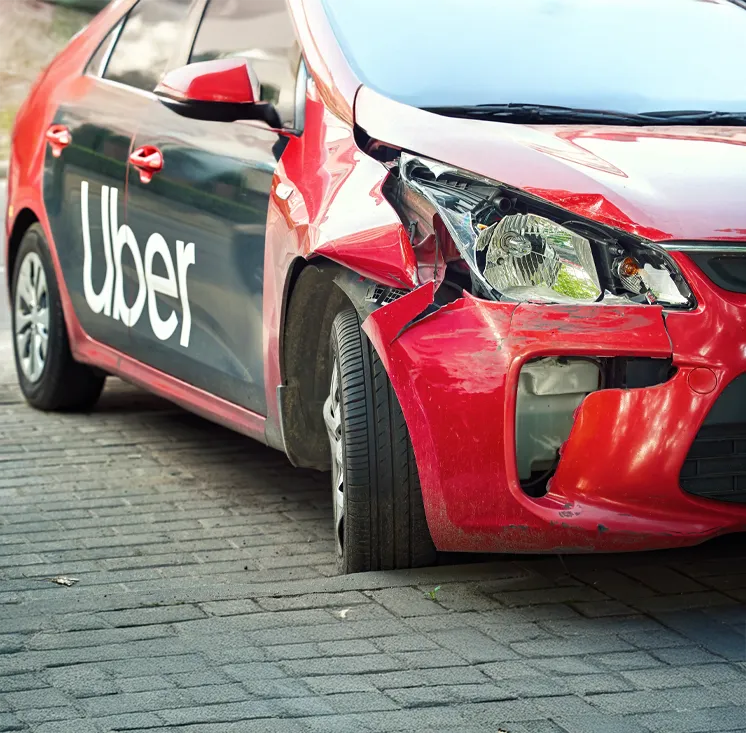
Most rides end the way they should. When one does not, working out who pays for the injuries is harder than in an ordinary two-car crash, because a rideshare collision can put three insurance policies in play at once.
Which one responds comes down to a single question: what was the driver’s app doing at the moment of impact.
Why these are not normal car accidents
In a standard crash, the at-fault driver’s personal auto policy covers the damage. Rideshare works differently. Uber and Lyft drivers are independent contractors rather than employees, and personal auto policies routinely exclude accidents that happen while the car is being used commercially.
Uber and Lyft each carry contingent liability coverage to fill that gap. It applies in stages.
The three phases
App off. The driver is just a motorist. No rideshare coverage applies and their personal policy handles the claim.
App on, no ride accepted. Limited liability coverage from Uber or Lyft becomes available. It generally kicks in where the driver’s personal insurer denies the claim or falls short, and the limits are lower than during an active trip.
Ride accepted, or passenger on board. Once a request is accepted — whether the driver is en route to a pickup or carrying someone — the higher commercial policy generally applies. This is where the largest limits sit.
| Trip phase | Primary coverage | Coverage level |
|---|---|---|
| App turned off | Driver’s personal auto policy | Standard personal liability limits |
| App on, no ride accepted | Contingent coverage from Uber or Lyft | Limited third-party liability |
| Ride accepted or in progress | Commercial policy from Uber or Lyft | Substantially higher limits, broader protection |
These structures change as insurance requirements change, so the policy terms in force on the day of the crash are what matter.
Who can bring a claim
- A passenger hurt during the trip
- The driver of another vehicle in the crash
- A pedestrian or cyclist struck by the rideshare vehicle
- A passenger in another vehicle involved
Each of these can pull in a different combination of policies depending on fault and phase.
Fault still has to be established
Responsibility may sit with the rideshare driver, with another motorist, with both under shared fault, or occasionally with a third party such as a manufacturer where a mechanical failure caused the crash.
Illinois applies modified comparative negligence, so compensation drops by your share of the fault, and at 51 percent or more you recover nothing.
What tends to cause them
- Distraction from checking the app for requests or navigation
- Sudden stops while hunting for a pickup or drop-off point
- Unfamiliarity with the area producing last-second lane changes
- Fatigue after long hours driving
- Speeding to fit in more trips
Why they get complicated
A single crash can involve the driver’s personal insurer, Uber or Lyft’s commercial carrier, and another driver’s company. Each has an incentive to point at the others. That slows everything down and depresses offers when the claim is not documented tightly from the start.
Evidence to preserve
- Screenshots of the app showing trip status and timestamps
- The trip receipt or ride confirmation
- The police report
- Photographs of vehicle damage and the scene
- Contact information for witnesses
- Medical records covering injuries and treatment
The trip status in the app is the single most valuable item on that list, because it decides which policy applies. Capture it early.
What to do after the crash
- Get medical attention, even if you feel fine
- Report it through the Uber or Lyft app as well as to police
- Photograph the vehicles, the scene, and any visible injuries
- Save screenshots of the trip details before they get harder to reach
- Collect contact information for the driver, other parties, and witnesses
- Do not accept a settlement before you know the full extent of your injuries
Rideshare companies start their own internal review as soon as an accident is reported. Moving early keeps you level with them.
Where we help
These claims usually mean negotiating with more than one insurer at a time, each with its own adjuster and its own interest in paying less. We identify which policy applies based on the trip phase, pull the app data and trip records while they are still available, value the claim in full, deal with Uber, Lyft, or the third-party carrier directly, and file within the deadline when it comes to that.
It is worth calling if the injuries required hospitalization or surgery, if there is a dispute over which policy applies, if fault is unclear or several vehicles were involved, or if an insurer has already denied or undervalued what happened to you.
Common questions
I was a passenger. Am I covered? Usually yes. Passengers hurt during an active trip generally fall under the commercial liability policy, since the trip was in progress.
What if the other driver caused it? Their personal auto insurance is normally the primary source. Depending on the circumstances, uninsured or underinsured coverage through the rideshare policy may also apply.
Does app status really matter that much? Yes. It determines which policy responds and how much coverage exists. It is the first thing worth documenting.
How long do I have to file? Generally two years from the date of the accident in Illinois, though specific circumstances can change that.
I was a pedestrian. Can I claim? Yes. Depending on the trip phase you may have a claim against the driver’s insurance, the rideshare company’s policy, or both.