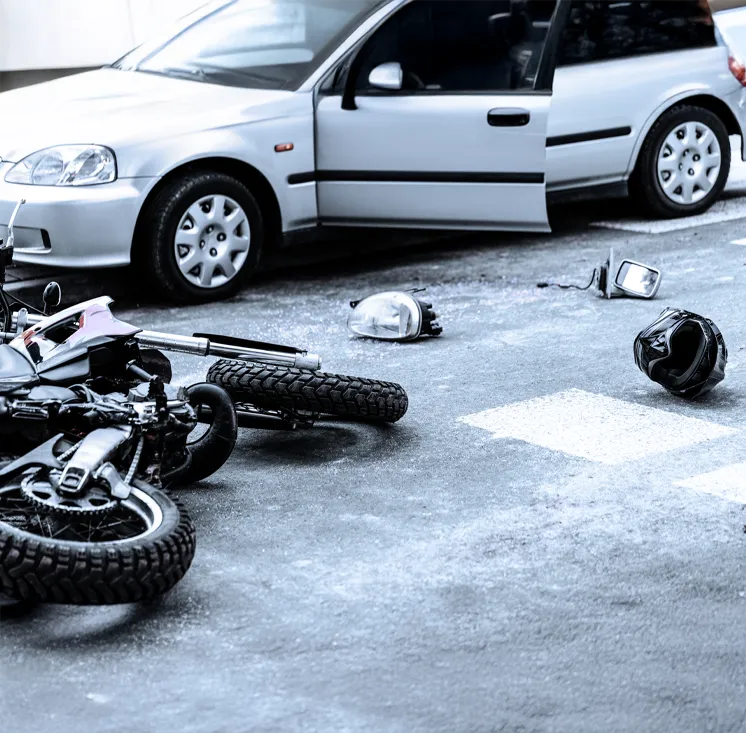
A motorcyclist who gets hit has two problems. The first is the injury. The second is the assumption, held by adjusters and jurors and sometimes written into the police report, that a rider on two wheels was probably doing something reckless.
That assumption is not in the law. It still costs riders money.
Where the assumption comes from
People who do not ride tend to picture motorcyclists a particular way: fast, weaving, taking chances. Coverage of crashes leans on that image. Most drivers have never ridden and do not know how a motorcycle actually handles, brakes, or gets hidden in a blind spot. And because motorcycle injuries tend to be visible and severe, there is a reflex to read the severity as proof the rider did something wrong, rather than proof that a two-ton vehicle hit an unprotected person.
The assumptions that show up most often
- The rider was speeding, with nothing in the evidence to support it
- The rider was not visible, no matter what the lighting or road conditions were
- Lane splitting or filtering happened, even where it plainly did not
- Whether the rider wore gear somehow settles who caused the crash
- The seriousness of the injury proves reckless riding rather than the force of the impact
None of that is Illinois law. All of it can shape an adjuster’s first offer.
What Illinois law actually says
Illinois applies the same negligence rules to motorcyclists as to everyone else. A driver who fails to yield, follows too closely, or changes lanes without checking a blind spot is responsible for hitting a motorcycle exactly as they would be for hitting a car.
Riders have full use of the road. Other drivers owe them the same duty of care they owe any other vehicle. When a driver breaches that duty and someone gets hurt, ordinary personal injury principles decide the case.
How these crashes usually happen
- A driver changes lanes without checking the blind spot
- A vehicle turns left across the path of an oncoming motorcycle
- A driver follows too closely and cannot stop in time
- Distraction delays a driver’s reaction
- A driver fails to yield at an intersection or while merging
In most of these, the rider had little chance to avoid the collision no matter how carefully they were riding.
How bias turns into a lower offer
Adjusters are paid to reduce payouts. An existing prejudice against riders is a useful tool for that. It surfaces as an assignment of partial fault to the rider with no real evidence behind it, or as a low offer justified by the theory that a jury will not warm to a motorcyclist the way it would to someone in a sedan.
Which is why a rider’s claim needs to rest on objective proof rather than on an adjuster’s sense of fairness.
Evidence that answers the assumption
Motorcycle claims get more scrutiny, so early documentation matters more:
- Photographs of the scene, the damage to both vehicles, and the road conditions
- Statements from witnesses who saw what happened
- The police report, including any citation issued to the other driver
- Surveillance or traffic camera footage where it exists
- Data from the motorcycle itself, such as speed or braking information
- Medical records establishing what the injuries are and how serious
Together these build a factual account of one crash, which is harder to argue with than a generalization about motorcyclists.
Helmets and gear
Wearing a helmet does not determine fault. Illinois has no universal helmet law for adult riders, so the presence or absence of one is generally not evidence of negligence in causing a crash. Insurers still raise it, usually to argue about how severe the injuries should have been rather than about who caused them.
What to do after a crash
- Get medical attention immediately, even if you feel mostly fine
- Call the police and make sure a report gets filed
- Photograph the scene, the vehicles, and any visible injuries
- Get contact information from witnesses
- Do not discuss fault or apologize at the scene, since it will be quoted back to you
- Talk to a lawyer before giving a recorded statement to an insurer
Each of these builds the factual record that assumptions have to survive later.
Where a lawyer helps
Handling one of these claims alone leaves a rider exposed to an offer built on guesswork. An attorney who handles motorcycle cases can:
- Gather the objective evidence that counters assumption-driven arguments
- Identify every liable party and every applicable policy
- Bring in accident reconstruction when the mechanics of the crash are disputed
- Negotiate with the adjuster directly
- Value the claim fully, including medical costs, lost income, and other damages
If you were hurt riding in the Chicagoland area, we are happy to look at what happened and tell you honestly what we think.