Getting hit by someone who then drives off leaves you with two problems at once: an injury, and no obvious person to hold responsible for it.
The second problem is more solvable than it looks. Illinois law and standard auto coverage both anticipate this exact situation.
What counts as a hit-and-run
Illinois requires any driver in an accident involving injury, death, or property damage to stop and give their name, address, and vehicle registration. Leaving without doing that is a hit-and-run, and it does not matter who caused the underlying crash.
It applies the same whether the collision involved another car, a cyclist, or a pedestrian. Fleeing is a separate offense from the crash, carrying its own criminal penalties on top of any civil liability for the injuries.
What it usually looks like
- A vehicle strikes another car and leaves before police arrive
- A driver hits a parked car and leaves no note
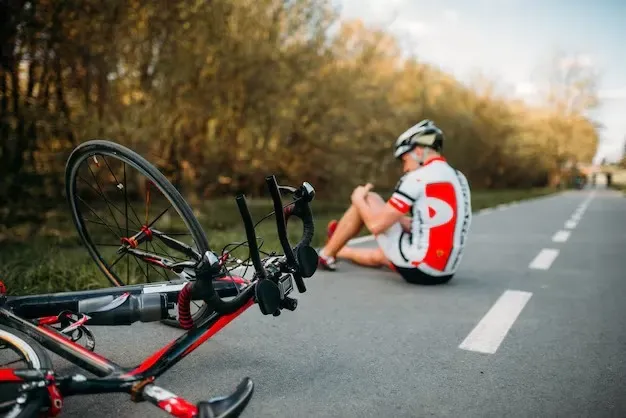
- A vehicle strikes a cyclist and keeps going
- A pedestrian is hit in a crosswalk by a driver who does not stop
- A parking lot collision where the responsible driver leaves nothing behind
The first hour matters
- Call 911 and report it, even if the injuries seem minor
- Note whatever you can about the fleeing vehicle — color, make, model, any part of the plate
- Look around for security cameras, traffic cameras, or witnesses
- Get medical attention and keep every record
- Notify your own insurer as soon as you can
- Do not guess or fill in details you are unsure about when talking to police or insurers
Even partial information helps. Color and general vehicle type is often enough to give investigators something to work with, and it supports the insurance claim either way.
How you get paid when nobody is found
This is the question everyone asks, and Illinois answers it mainly through uninsured motorist coverage.
Uninsured motorist (UM) coverage exists for exactly this: the at-fault driver cannot be identified, or carries no insurance. If you have it on your own policy, it can cover medical expenses, lost income, and other damages even though the driver was never located. Illinois requires insurers to offer UM coverage, though drivers are allowed to decline it in writing — so it is worth checking your declarations page rather than assuming.
Underinsured motorist (UIM) coverage matters when the driver is eventually found but carries minimal limits. It fills the gap between what their policy pays and what the claim is actually worth.
| Situation | Likely source of compensation | What it turns on |
|---|---|---|
| Driver never identified | Uninsured motorist coverage | The terms and limits of your own policy |
| Driver identified but underinsured | Underinsured motorist coverage | Whether their liability limits fall short |
| Driver identified and insured | Their liability insurance | Proceeds as a standard liability claim |
| Pedestrian or cyclist injured | UM coverage or another applicable policy | Which policies extend to the injured person |
Cyclists
Cyclists come off worse in these crashes and usually have less ability to document anything at the scene. Illinois protects them on the road much as it does other motorists, and a driver who strikes a cyclist and leaves carries the same obligations as in any other collision.
Coverage for an injured cyclist often runs through a policy attached to a household vehicle rather than anything connected to the bicycle, which is not obvious to most people until someone points it out.
Why drivers flee
Investigations frequently find that the driver who left was distracted, impaired, or both, and fled precisely to avoid the consequences. That is worth knowing, because it shapes what evidence is worth chasing — sudden lane departure or delayed braking before impact tends to point in the same direction.
If the driver is identified later
Police do sometimes find them days or weeks on, through witness tips, camera footage, or body damage matching the crash. When that happens the case generally converts into an ordinary injury claim against their insurance, alongside whatever criminal charges follow from leaving.
This is the argument for documenting everything at the time even when the driver is long gone. Evidence collected on day one becomes the backbone of the claim if a name surfaces on day forty.
Evidence that carries these claims
- The police report, including any description of the fleeing vehicle
- Nearby surveillance or traffic camera footage
- Witness statements and contact details
- Photographs of damage, road conditions, and the scene
- Medical records tying the injury to the crash
- Your own policy documents showing UM coverage
Surveillance footage is usually overwritten within days. If it exists, someone has to ask for it quickly.
Do not skip the police report
Even when the driver is never found, the report is what makes the insurance claim work. It creates an official record of the incident, whatever was known about the vehicle, and the responding officer’s initial read. Insurers generally require it before processing a UM claim.
Where a lawyer helps
Because these claims run through your own insurer, they can turn adversarial in a way people do not expect, particularly if the company disputes how the crash happened or how badly you were hurt. We review the policy to confirm what actually applies, preserve evidence before it disappears, deal with your insurer on your behalf, value the claim properly, and pursue the driver directly if they are identified later.
Talk to us
If a driver hit you and left, it is worth understanding what coverage you have before you start negotiating with your own insurance company alone. Tell us what happened and we will explain where your claim stands.
Common questions
What do I do first? Call 911, get medical attention, and document whatever you can about the vehicle. Reporting promptly preserves evidence and supports the claim later.
Can I recover if they are never found? Usually yes, through uninsured motorist coverage on your own policy, assuming you carry it.
How do I know if I have UM coverage? Illinois insurers must offer it, but policyholders can decline in writing. Your policy documents will tell you.
What if I was walking or cycling? Pedestrians and cyclists can often claim through uninsured motorist coverage, which sometimes reaches beyond the vehicle itself.
How long do I have? Generally two years from the date of the accident, though your policy may impose its own notice deadline that hits much sooner.