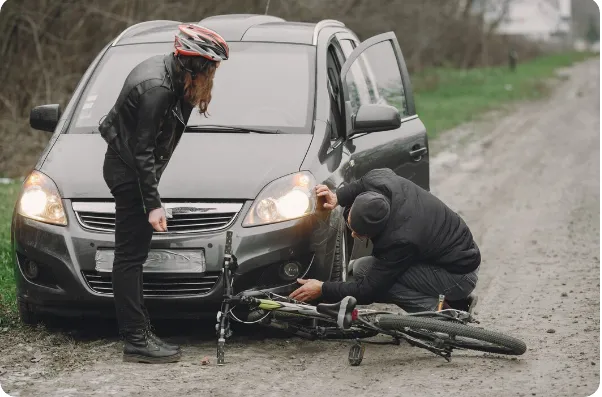
A cyclist has almost nothing between them and a car. That imbalance shows up twice: first in the severity of the injuries, and again in how the claim gets handled afterward.
Who is responsible
Bicycle collisions happen for familiar reasons — distracted driving, failure to yield, speeding, unsafe lane changes, dooring, bad road conditions, and occasionally defective bicycle components.
Depending on what happened, responsibility can rest with:
- A driver
- A government agency responsible for maintaining the road
- A bicycle or component manufacturer
- A property owner
- More than one of the above
Sorting this out early matters, because a claim against a municipality follows different rules and much shorter notice deadlines than one against a driver.
Why representation changes the outcome
Most people assume an insurer will evaluate their claim fairly. Insurers investigate claims to limit what they pay. Those are not the same activity, and a cyclist negotiating alone is usually not aware of the difference until the first offer arrives.
| What a lawyer does | Why it protects you |
|---|---|
| Collects evidence | Establishes fault while the proof still exists |
| Handles negotiation | Keeps a low first offer from becoming the final one |
| Assesses damages | Makes sure future costs are counted, not just current bills |
| Advises on options | Clarifies what a claim is realistically worth |
| Litigates | Provides a credible alternative to settling cheap |
Building the case
A proper investigation usually pulls together the police report, witness statements, medical records, photographs and video, traffic camera footage where it exists, and — in disputed cases — expert opinion or accident reconstruction.
Insurance negotiations
Insurers often request a recorded statement soon after a crash. Cooperation has limits, and statements given early get used later to challenge liability or argue your injuries were less serious than they are.
The practical value of having someone else handle this is that they review the communications, run the negotiation, recognize the standard tactics, submit documentation correctly, and evaluate any offer against what the claim is actually worth. Accept too early and you have waived the future medical costs you did not know about yet.
What the claim should cover
Economic damages are the measurable losses: medical expenses, rehabilitation, lost wages, reduced earning capacity, property damage.
Non-economic damages cover pain and suffering, emotional distress, loss of enjoyment of life, permanent disability, and disfigurement.
Serious cycling injuries frequently require ongoing treatment, which is exactly the category people forget to count.
The injuries these crashes produce
Traumatic brain injuries. A helmet reduces risk. It does not eliminate it. TBIs can leave lasting cognitive, emotional, and physical effects.
Spinal cord injuries. Chronic pain, restricted mobility, sometimes permanent disability.
Fractures and orthopedic injuries. Common, and frequently requiring surgery and extended rehabilitation.
Road rash and soft tissue damage. Severe abrasions can lead to infection and permanent scarring.
When a lawsuit is necessary
Most bicycle claims settle. Litigation becomes the right move when liability is genuinely disputed, coverage is insufficient, negotiations stall, or multiple parties are pointing at each other. From there it means filing, discovery, presenting evidence, examining witnesses, and trying the case if it comes to that.
What to do after a crash
Get medical attention immediately, even if you feel able to ride home. Call the police and get a copy of the report. Photograph the vehicles, the roadway, your bicycle, and your injuries. Collect witness contact information. Then talk to someone before you give a statement to an insurer.
If you were hit while riding anywhere in the Chicagoland area, we are glad to look at it and tell you what we think.